Posted on February 10th, 2026 / V-Star Energy
If you’re planning a new build in Australia, the term “concrete slab edge insulation” has likely appeared on your energy efficiency plans. A common question we hear is: “Do we really need this? Can we remove it to save cost?”
At V-Star Energy, we understand this query. The answer is not a simple yes or no, but rather: “It depends on your specific design and location, and when required, it is a non-negotiable part of the National Construction Code (NCC).”
This blog clarifies the precise rules, explains the critical benefits, and highlights why this detail is so important for your project’s success.
🏛️ The NCC Rule: When Is It Mandatory?
The NCC mandates slab edge insulation under specific, high-impact conditions. Its primary purpose is to “break” a major thermal bridge, preventing costly heat loss.
You must install slab edge insulation for a conventional raft slab if any one of the following applies to your project:
- Location in a Cooler Climate: The building is in NCC Climate Zone 6, 7, or 8 (e.g., much of Victoria, Tasmania, and the alpine regions, and some coastal areas in southern NSW).
- Installation of In-Slab Heating: Any form of in-slab heating is used, regardless of your climate zone.
Important Exemption: The requirement typically does not apply to waffle pod slab (ribbed raft) systems where the pods are in direct contact with the ground.
Key Takeaway: Removing this insulation from a compliant design where it is mandated could result in a failed building inspection. It is not an optional extra but a calculated, code-required component for many projects.
📏 The Mandatory Specification: Depth & Material
When the conditions above are met, the installation must be precise to be effective and compliant:
- It must be continuous around the exposed perimeter.
- It must extend from the ground level down to a depth of at least 300mm or the full depth of the slab edge—whichever is greater.
- The material must be water-resistant (such as specific grades of extruded polystyrene – XPS) to withstand ground moisture.
👍 The Benefits: More Than Just a Tick-Box
While compliance is paramount, correctly installed slab edge insulation delivers tangible benefits that improve the building’s energy rating performance and liveability:
- Increased Comfort: It dramatically reduces cold floors and draughts along external walls, making homes feel consistently warmer in winter.
- Reduced Energy Bills: By blocking a major path for heat loss, it lowers the workload on heating systems, leading to long-term energy savings.
- Prevention of Condensation: In cooler climates, it keeps the slab edge warmer, reducing the risk of dampness and mould growth caused by condensation.
- Protection for In-Slab Heating: It is essential for trapping heat within the slab, ensuring the system is efficient and cost-effective to run.
💡 A Note for Builders and Developers
We know every line item counts. However, the cost of compliant slab edge insulation is minimal compared to the risks of:
- Failed inspections and costly rectification.
- An underperforming, inefficient building that fails to meet occupant expectations.
- Higher long-term energy costs for homeowners.
Specifying and installing it correctly from the outset is the most professional and efficient path, ensuring quality and compliance.
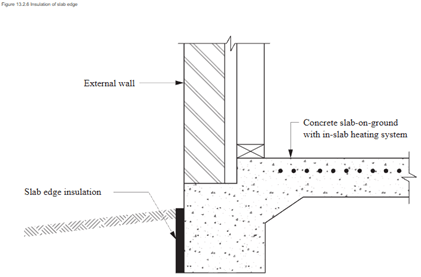
Excerpt from the National Construction Code:
(6) Insulation required by (4), (5)(a)(i) and (5)(b)(i) must—
- be water resistant; and
- be continuous from the adjacent finished ground level—
- to a depth of greater than or equal to 300 mm; or
- for at least the full depth of the vertical edge of the concrete slab-on-ground (see Figure 13.2.6).
© Commonwealth of Australia and the States and Territories 2022, published by the Australian Building Codes Board.
🤝 How V-Star Energy Can Help
As your accredited energy assessors, our role is to model your building’s true thermal performance. When we include slab edge insulation in your NatHERS assessment, we are modelling the design as it must be built to meet the NCC.
We are here to help you navigate these requirements seamlessly. If you are unsure whether your project triggers the mandatory rules, or need advice on specifications, please ask us during the design phase.
Need clarity on your project’s specific compliance requirements?
Contact the V-Star Energy team today for confident, accurate advice.
V-Star Energy – Precision Energy Compliance for Smarter Buildings.

 Building Thermal Rating Assessors