Don’t Get Cold Feet: Why Slab Edge Insulation Is Often a Mandatory Must-Have

Posted on February 10th, 2026 / V-Star Energy

If you’re planning a new build in Australia, the term “concrete slab edge insulation” has likely appeared on your energy efficiency plans. A common question we hear is: “Do we really need this? Can we remove it to save cost?”

At V-Star Energy, we understand this query. The answer is not a simple yes or no, but rather: “It depends on your specific design and location, and when required, it is a non-negotiable part of the National Construction Code (NCC).”

This blog clarifies the precise rules, explains the critical benefits, and highlights why this detail is so important for your project’s success.


🏛️ The NCC Rule: When Is It Mandatory?

The NCC mandates slab edge insulation under specific, high-impact conditions. Its primary purpose is to “break” a major thermal bridge, preventing costly heat loss.

You must install slab edge insulation for a conventional raft slab if any one of the following applies to your project:

  1. Location in a Cooler Climate: The building is in NCC Climate Zone 6, 7, or 8 (e.g., much of Victoria, Tasmania, and the alpine regions, and some coastal areas in southern NSW).
  2. Installation of In-Slab Heating: Any form of in-slab heating is used, regardless of your climate zone.

Important Exemption: The requirement typically does not apply to waffle pod slab (ribbed raft) systems where the pods are in direct contact with the ground.

Key Takeaway: Removing this insulation from a compliant design where it is mandated could result in a failed building inspection. It is not an optional extra but a calculated, code-required component for many projects.


📏 The Mandatory Specification: Depth & Material

When the conditions above are met, the installation must be precise to be effective and compliant:

  • It must be continuous around the exposed perimeter.
  • It must extend from the ground level down to a depth of at least 300mm or the full depth of the slab edge—whichever is greater.
  • The material must be water-resistant (such as specific grades of extruded polystyrene – XPS) to withstand ground moisture.

👍 The Benefits: More Than Just a Tick-Box

While compliance is paramount, correctly installed slab edge insulation delivers tangible benefits that improve the building’s energy rating performance and liveability:

  1. Increased Comfort: It dramatically reduces cold floors and draughts along external walls, making homes feel consistently warmer in winter.
  2. Reduced Energy Bills: By blocking a major path for heat loss, it lowers the workload on heating systems, leading to long-term energy savings.
  3. Prevention of Condensation: In cooler climates, it keeps the slab edge warmer, reducing the risk of dampness and mould growth caused by condensation.
  4. Protection for In-Slab Heating: It is essential for trapping heat within the slab, ensuring the system is efficient and cost-effective to run.

💡 A Note for Builders and Developers

We know every line item counts. However, the cost of compliant slab edge insulation is minimal compared to the risks of:

  • Failed inspections and costly rectification.
  • An underperforming, inefficient building that fails to meet occupant expectations.
  • Higher long-term energy costs for homeowners.

Specifying and installing it correctly from the outset is the most professional and efficient path, ensuring quality and compliance.

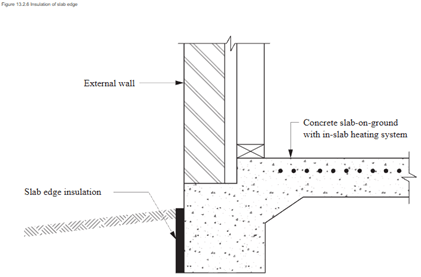
Excerpt from the National Construction Code:

(6) Insulation required by (4), (5)(a)(i) and (5)(b)(i) must—

  1. be water resistant; and
  2. be continuous from the adjacent finished ground level—
    1. to a depth of greater than or equal to 300 mm; or
    2. for at least the full depth of the vertical edge of the concrete slab-on-ground (see Figure 13.2.6).
© Commonwealth of Australia and the States and Territories 2022, published by the Australian Building Codes Board.


🤝 How V-Star Energy Can Help

As your accredited energy assessors, our role is to model your building’s true thermal performance. When we include slab edge insulation in your NatHERS assessment, we are modelling the design as it must be built to meet the NCC.

We are here to help you navigate these requirements seamlessly. If you are unsure whether your project triggers the mandatory rules, or need advice on specifications, please ask us during the design phase.

Need clarity on your project’s specific compliance requirements?
Contact the V-Star Energy team today for confident, accurate advice.


V-Star Energy – Precision Energy Compliance for Smarter Buildings.

NCC 2025 Preview: Key Changes for Builders and Developers

Posted on February 5th, 2026 / V-Star Energy

The Australian Building Codes Board (ABCB) has released its much-anticipated NCC 2025 preview, setting the direction for the next wave of building regulations. While this is a preview and details may evolve before the final publication, the core priorities are clear.

At V-Star Energy, our first read is that NCC 2025 is not a revolution, but a significant evolution. It focuses on safety enhancements, closing performance gaps, and providing much-needed clarity on energy efficiency, particularly for commercial and multi-residential projects.

This blog breaks down the key proposed changes so you can start planning.


The Headline Decision: A Pause on New Residential Energy Rules

Before detailing the 2025 changes, it’s crucial to address the biggest news from the Building Ministers’ Meeting in October 2025: a strategic pause on new residential energy efficiency and sustainability changes until mid-2029.

What this means for you:

  • No new residential energy targets. The current 7-star NatHERS + Whole-of-Home requirements from NCC 2022 remain the standard.
  • Deferred proposals, including new electric vehicle (EV) charging requirements for houses and further residential energy upgrades, will not proceed at this time.
  • Certainty for builders and designers. This pause provides a stable, predictable regulatory environment for residential projects for the next four years.

Why it matters: This decision allows the industry to consolidate and build expertise around the current 7-star standard while focusing on housing supply. It does not, however, affect the significant commercial building updates confirmed for NCC 2025.


🏗️ Key Proposed Changes in the NCC 2025 Preview

The preview confirms several substantial updates, particularly for commercial and apartment buildings, as well as critical safety improvements. Below is a summary of the key proposed changes expected to come into effect from 1 May 2026.

Area of ChangeWhat’s Proposed (NCC 2025 Preview)Impact & Who Needs to Know
Commercial & Apartment Energy Efficiency (Section J)Enhanced glazing standards (e.g., J4D6), mandatory variable-speed fans for larger HVAC systems (J6D5), and mandatory on-site solar PV for new commercial buildings (J9D5).Commercial developers, builders, and architects. This will increase upfront costs but significantly reduce operational energy use. Early design integration is key.
Fire SafetyMandatory sprinklers in new carparks with >40 spaces, use of hybrid photoluminescent exit signs, and removal of the “Expert Judgement” pathway for fire safety design.All builders, fire engineers, and building surveyors. Aims to improve real-world safety and standardise compliance.
Waterproofing & CondensationConsolidation of waterproofing provisions (Parts F1 & F3) and stricter condensation management requirements for walls and roofs in Climate Zones 6-8.All builders and waterproofing specialists. Aims to reduce building defects and moisture-related damage.
Embodied Carbonvoluntary pathway for embodied carbon reporting will be published as guidance, not mandated in the code. Formal regulation is expected in NCC 2028.Forward-thinking developers and sustainability managers. An opportunity for early adoption and market differentiation.
Accessibility & LivabilityImproved minimum accessibility standards for housing, enhanced indoor air quality measures, and requirements to support future home electrification (e.g., switchboard capacity).Volume builders, developers, and architects. Focuses on occupant health, future-proofing, and universal design.

💡 What This Means for Your Projects

  • For Residential Builders & Designers: You can proceed with confidence under the stable NCC 2022 rules. Use this period to master the 7-star Whole-of-Home requirements and improve build quality. Consider voluntarily adopting electrification-ready wiring to future-proof homes.
  • For Commercial & Apartment Developers: Start preparing now. The Section J and solar PV changes will impact building services design, facade specifications, and project budgets. Engage your energy consultant (like V-Star Energy) early in the design phase to model compliance and optimise costs.
  • For Everyone: The focus on condensation management and waterproofing is a reminder that build quality is paramount. Ensuring these details are correct from the start avoids costly rectifications.

🚀 Our Commitment at V-Star Energy

The NCC 2025 preview confirms the industry’s direction towards higher-performance, safer, and more sustainable buildings. While the residential pause provides stability, the commercial changes are substantive.

Our team is already analysing the preview’s technical details. We are your partner in navigating this transition, ensuring your projects are not only compliant but also cost-optimised and future-ready.

Have questions about how NCC 2025 might affect your upcoming project?
Contact V-Star Energy today for clear, expert advice tailored to your specific needs.


V-Star Energy – Precision Energy Compliance for Smarter Buildings

Embracing the Next Generation of WSUD Reporting: V-Star Energy Transitions to Blue Factor


23 October 2025 | V-Star Energy

Change is on the horizon for Water Sensitive Urban Design (WSUD) reporting in Victoria. The well-known STORM tool is now retired, and a new, modernised platform—Blue Factor—is taking its place.

Our team at V-Star Energy has already completed the transition to Blue Factor, ensuring a seamless and uninterrupted service for all your projects.


What is Blue Factor?

Blue Factor is the official successor to the STORM tool, designed to help assess stormwater runoff and pollutants from a development and determine the treatment measures needed.

Like its predecessor, it is intended for use with small-scale developments of less than 1 hectare, including small-scale residential and simple commercial projects.


Why This Change Reinforces the Importance of WSUD

This tool update is part of a continued commitment to protecting our waterways. WSUD is an approach that integrates the water cycle into urban planning, treating stormwater as a valuable resource rather than a nuisance.

The core goals remain the same:

  • Protecting and enhancing our creeks, rivers, and wetlands.
  • Improving the quality of water draining from urban areas.
  • Restoring the water balance by reusing stormwater where possible.

Using the correct, up-to-date tool to demonstrate how your development meets these goals is a mandatory step in the planning process for most new developments in Victoria.


Your Partner for a Smooth Transition

The shift from STORM to Blue Factor is more than just a change of software. It represents an evolution in how we manage urban water. At V-Star Energy, we have invested in the transition and have already successfully integrated Blue Factor into our workflow.

By working with us, you benefit from:

  • No Delays: Immediate capability to produce compliant Blue Factor reports for your new projects.
  • Expert Guidance: Clear advice on how the transition impacts your current and upcoming projects.
  • Peace of Mind: Confidence that your WSUD compliance is handled with the most current and council-accepted tools.

Ready for Your Next Project? Don’t let regulatory changes slow down your development timeline. If you have a project in the pipeline that requires WSUD reporting, contact Stephen at V-Star Energy today.