
As part of the planning application process for both residential and commercial building projects, Council may require a Water Sensitive Urban Design (WSUD) report that presents the commitments for filtering and storing rainwater that achieve pollutant reduction targets in Blue Factor.
Our experienced consultants will help you to identify the optimal WSUD approach that achieves Best Practice stormwater treatment options at the lowest cost to your building project. We will tailor the treatment measures and report content to local Council requirements to obtain prompt approval of your project.
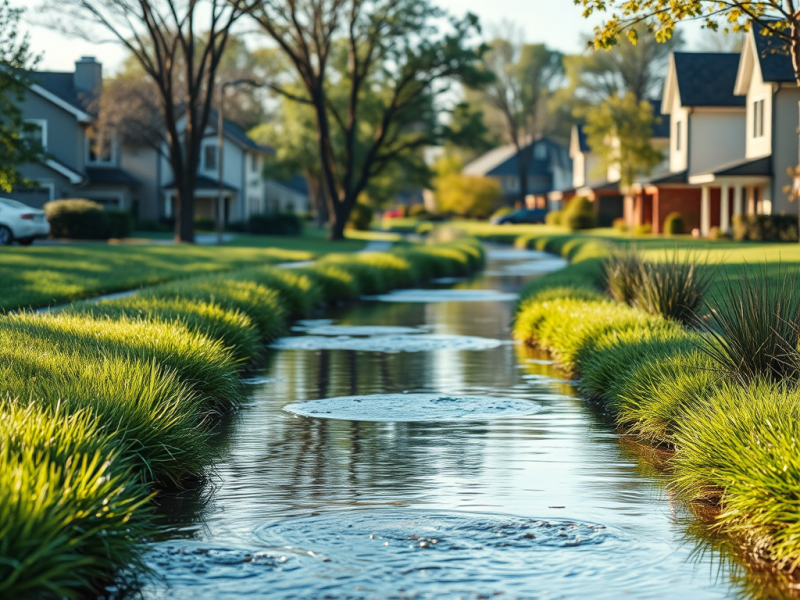
We assess impervious areas, such as rooftops, paths and driveways, and model a suitable approach to water treatment. This will typically include one or a combination of treatment measures, such as rainwater tanks, rain gardens, buffer strips and permeable paving.
We provide you with a report that not only supports your planning application, but is a valuable on-going resource for the building occupants. It includes a detailed explanation of the WSUD approach and installation, and any on-going maintenance required to ensure effective operation over time.
“V-Star Energy has been an impeccable company to work with. Their recent services for our Verdant Hills project was second to none. We look forward to a continued relationship with V-Star Energy!”
Charlie Wardan, Managing Director

Don’t Get Cold Feet: Why Slab Edge Insulation Is Often a Mandatory Must-Have
Posted on February 10th, 2026 / V-Star Energy If you’re planning a new build in Australia, the term “concrete slab edge insulation” has likely appeared on your energy efficiency plans. A common question we hear is: “Do we really need this? Can we remove it to save cost?” At V-Star Energy, we understand this query. The answer…

NCC 2025 Preview: Key Changes for Builders and Developers
Posted on February 5th, 2026 / V-Star Energy The Australian Building Codes Board (ABCB) has released its much-anticipated NCC 2025 preview, setting the direction for the next wave of building regulations. While this is a preview and details may evolve before the final publication, the core priorities are clear. At V-Star Energy, our first read is…
Embracing the Next Generation of WSUD Reporting: V-Star Energy Transitions to Blue Factor
23 October 2025 | V-Star Energy Change is on the horizon for Water Sensitive Urban Design (WSUD) reporting in Victoria. The well-known STORM tool is now retired, and a new, modernised platform—Blue Factor—is taking its place. Our team at V-Star Energy has already completed the transition to Blue Factor, ensuring a seamless and uninterrupted service for…
 Building Thermal Rating Assessors